styles
Yagasuri arrow patterns
Arrow feathers in columns, each column set half a step lower, with plain or striped feathers at two angles.
















































No patterns match this color.
The anatomy of the yagasuri pattern
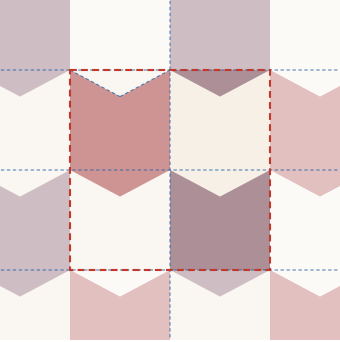
Yagasuri is built from upright strips of equal width. Down each strip runs a stack of chevrons, every one shaped like the fletching at the back of an arrow, with its center sunk a little below its two ends. Filled and empty chevrons alternate down the strip. The strip next to it is shifted by exactly one chevron, so a filled one always has an empty neighbor, and the zigzag edges still join up.
Yagasuri is the arrow-feather pattern of kimono cloth. It was first a woven kasuri, the Japanese form of ikat, in which threads are dyed in sections before they go on the loom. For the history, read the meaning and history of yagasuri.
Which yagasuri to pick
Besides color and size, two choices change the look. A shallow angle gives flat, wide chevrons; a steep angle gives sharp arrows. A feather can be one solid band, or two stripes, which doubles the lines and makes the pattern finer. With three or four colors, every second column of feathers has its own pair of colors, so the columns take turns. Half the patterns are turned a quarter, so the arrows fly sideways.
How to use yagasuri patterns
The pattern has a strong direction. Upright, it suits tall things: bookmarks, the spine of a journal, a phone wallpaper, ribbon and gift bags. Turned sideways, it becomes a running border for the bottom of a page or a banner. Red feathers on cream give it the look of old kimono cloth.
Printing tips
Keep the arrows pointing the same way across a whole project; on a wrapped box, decide which face is up before you cut the paper. The striped feathers have narrow lines that can blur at the smallest size on matte paper. For sublimation or fabric, test the steep angle first, since sharp points show any stretch in the print.
Where the name comes from
Ya is an arrow and kasuri is the cloth. The other names, yabane and yahazu, also come from the arrow: its feathers and its notch.
Sources: 矢絣 (Yagasuri), Japanese Wikipedia; Kasuri (Wikipedia)