Yagasuri: Meaning and History of the Pattern
Yagasuri (矢絣) is the Japanese arrow-feather pattern: columns of chevrons, each column set half a step lower than the next. It began as a woven ikat, with the warp dyed before weaving, and it was the fashionable cloth of schoolgirls and young women from the Meiji era into the early Shōwa era.
Also called: 矢絣
The anatomy of the yagasuri pattern
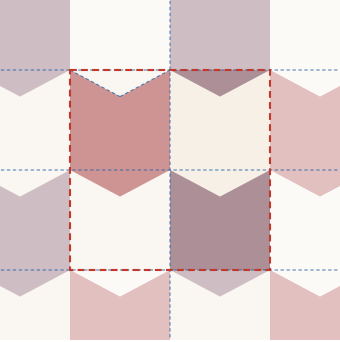
- The motif
- One feather: a band shaped like a wide V, as tall as a column is wide. Its middle dips about a quarter of the column width below its sides.
- The grid
- Columns of equal width, side by side. In each column, feathers stack one on top of the other, and colored and plain feathers take turns.
- The drop
- Every second column moves down by one feather. The V lines still meet across the columns, but each colored feather now sits beside a plain one, like the squares of a checkerboard.
- The repeat
- The smallest tile is two columns wide and two feathers tall, so it is square.
Draw it yourself
- On grid paper, draw upright lines to make columns of equal width.
- Mark the same height on every column line, one column width apart all the way down.
- In each column, draw a V from each mark on the left to a point about a quarter width lower in the middle, and back up to the mark on the right.
- In the first column, color every second feather. In the next column, color the other feathers, so colored and plain take turns across the columns.
- Do the same on every column. Erase the upright lines if you want the feathers to join.
What changes the look
A shallow V gives flat, wide chevrons; a steep V gives sharp arrows. A feather split into two stripes makes the pattern finer. With three or four colors, every second column can take its own pair of colors. Turn the pattern a quarter and the arrows fly sideways along a band.
Not the same as
- Ichimatsu: The colored and plain feathers take turns like the squares of ichimatsu, but each feather is a V, and the columns give the pattern a strong up-and-down direction.
The ya in yagasuri is an arrow, and the kasuri is a kind of cloth. Daijisen defines the word as a kasuri design that shows the shape of arrow feathers, the fletching at the back of an arrow. Other names are yabane, “arrow feathers”, and yahazu, the notch at the end of an arrow that sits on the bowstring; Daijisen also gives yahazu-gasuri. Japanese Wikipedia notes that one guide to Tokyo life from 1901 treats yahazu and yagasuri as two different patterns, so the names were not always interchangeable.
A pattern made in the loom
Kasuri is the Japanese form of ikat: the threads are dyed in sections before weaving, and the design appears as the cloth is woven. Japanese Wikipedia says yagasuri is a warp ikat (tate-gasuri), with the arrow shapes coming from the dyed warp threads. The Heibonsha World Encyclopedia describes the figure as an arrow-feather shape turned the other way in alternate rows, made by shifting the dyed warp into a V.
Nipponica gives the clearest description of the unit: an M and a V joined one above the other, bound by a vertical line in the middle, with the colors alternating, repeated across the whole cloth.
From Edo palaces to Meiji schoolgirls
Japanese Wikipedia says the pattern grew out of a striped cloth with checker-like kasuri, the kind seen in prints by Suzuki Harunobu and Kitagawa Utamaro, and that it took its present form in the late Edo period; it gives this as the received account, not a certainty. Women serving in the inner quarters of Edo-period households wore a striped kasuri called goten-gasuri, “palace kasuri”, woven in the Nishijin district of Kyoto on a ladder-type loom, a detail it takes from the Edo-period book Morisada Mankō.
In the Meiji and Taishō periods yagasuri became the fashion among schoolgirls and other young women, and it turns up in the literature of the time, Japanese Wikipedia says. Nipponica puts its popularity with young women from Meiji into the early Shōwa period and lists the cloths it was woven in: cotton, tsumugi pongee and omeshi crepe.
It was not only woven. Japanese Wikipedia records yagasuri stencils in Tokiwa kongata-zome, a stencil dyeing of the Sendai area, sometimes combined with cherry blossoms or the well-curb igeta motif, and the Edo-Tokyo Museum holds a yagasuri stencil. Our sources give the pattern no symbolic meaning.
How to use yagasuri
The pattern is strongly vertical, so it suits long things: borders, ribbon, spines of notebooks and wrapping paper. Turned 90 degrees, the arrows fly sideways along a band.
Pick the direction before you start. On a wrapped box or a bookmark, the feathers look best when they all point the same way.
Sources
- 矢絣 (Yagasuri), Japanese Wikipedia: technique, Edo origins, Meiji and Taishō fashion, stencils
- 矢絣, Kotobank (Nipponica, Heibonsha World Encyclopedia, Daijisen): the M and V unit, fabrics, and its popularity with young women