styles
Mandala patterns
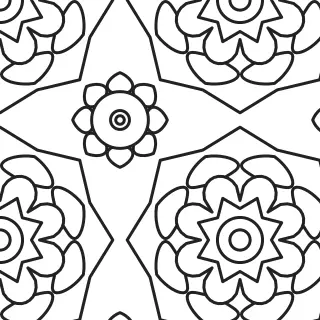
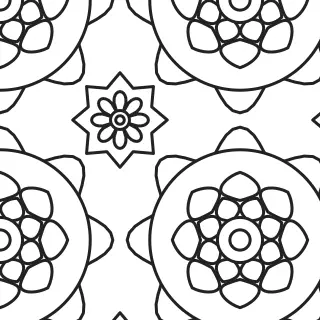
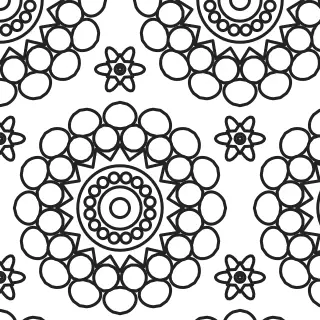
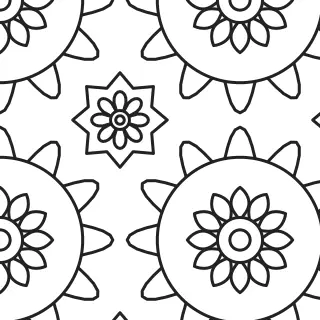
Round rosettes of petals, stars and dots, set on a grid and drawn as clean black lines for coloring.
No patterns match this color.
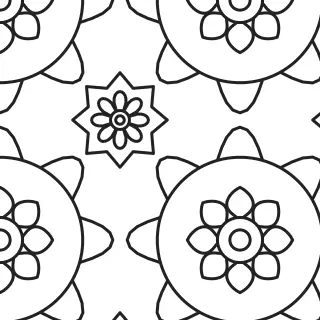
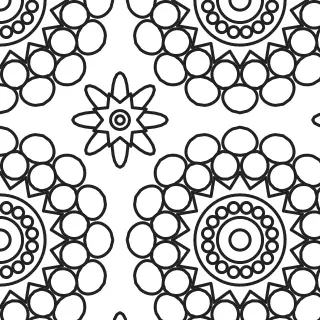
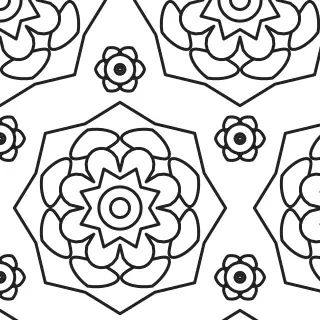
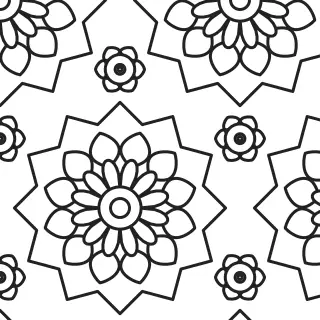
Each tile places a large rosette at every point of a square or hexagonal grid and a smaller one in the gaps between them. A rosette is drawn as a set of rings from the outside in: pointed or rounded petals, a scalloped or wavy edge, a star, a plain band, a ring of dots, then a center. The design repeats from 6 to 20 times around the circle, with a few or many layers of rings. Every ring is a closed shape, so each part can be filled with color without gaps.
Printing and coloring mandalas
Print the Letter or A4 sheet at 300 dpi on heavier paper when using markers, which can bleed through thin copy paper. Fewer petals and rings give larger spaces for young children or broad markers; more petals and rings give fine detail for colored pencils and gel pens. The hex grid packs the rosettes closer and leaves smaller gaps. A thicker line in the pattern generator helps with watercolor or for anyone who likes bold edges to stay inside.
Where does the word mandala come from?
Mandala is the Sanskrit word for circle. In Hinduism, Buddhism and Jainism the mandala is a symbol used as an aid to focus and meditation, and as a map of deities, sacred spaces or the cosmos. A basic form is a square with four gates around a circle with a center point; Buddhist mandalas often use concentric rings. These patterns are decorative rosettes that borrow only the radial form. They are not religious images and do not follow any ritual layout.
Sources: Mandala (Wikipedia)