Eight-pointed star: Meaning and History of the Pattern
The eight-pointed star is two squares laid over each other, one turned 45 degrees. Set beside cross-shaped tiles it covers a wall in the star-and-cross pattern of medieval Iranian tilework. As the Rub el Hizb it marks divisions of the text in some copies of the Quran and appears on several national flags.
The anatomy of the eight-pointed star pattern
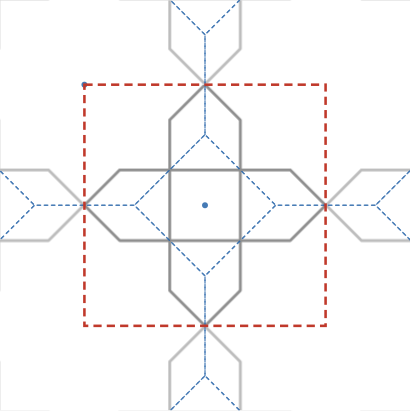
- The motif
- An eight-pointed star made of two equal squares, one turned 45 degrees over the other. Each of its eight points is a right angle.
- The grid
- A square grid with a star centered on every corner. All eight points of a star lie on a circle whose radius is half the grid side.
- The cross
- Neighboring stars meet point to point at the middle of each grid side. The space left between four stars is a cross, with a small square at its middle.
- The repeat
- The smallest tile is one grid square: a quarter of a star at each corner and one whole cross in the middle.
Draw it yourself
- Draw a square grid with a ruler and set square, and draw the diagonals of each square.
- Set the compass to half the grid side. Draw a circle around every grid corner. Neighboring circles touch at the middle of each grid side.
- On each circle, mark eight points: the four points where it touches its neighbors, and the four points where it crosses the diagonals.
- Join every second point to make a square. Join the other four points to make a second square, turned 45 degrees.
- Erase the lines inside the star, so only its outline of eight points is left.
- Look at the space between four stars: it is a cross. Carry the star lines on past the points across the gap, and they draw a small square in the middle of the cross.
What changes the look
With broad, right-angled points the pattern is calm and even, like a tiled floor. With narrower points, each star grows a ring of eight petals and a small four-pointed star sits where four rosettes meet; this looks busier and more ornamental. Two colors split stars from crosses. More colors let the crosses and the centers stand out.
Not the same as
- Six-pointed star: Two triangles instead of two squares, on a grid of hexagons, so the stars have six points and the gaps are small hexagons, not crosses.
- Twelve-point rosette: Also a star with a ring of petals, but with twelve points on a grid of triangles. It needs a larger space to read well.
Draw a square, then draw the same square again turned by 45 degrees around the same center. The corners of the two make eight points. The Islamic geometric patterns article on Wikipedia describes the star in exactly those terms: two squares, one rotated 45 degrees with respect to the other. In the language of geometry this is the octagram {8/2}, a compound of two squares, as the Octagram article puts it; the sharper star {8/3} connects every third of eight points instead.
Older than Islam, central to it
The shape itself is very old. The Octagram article shows an eight-pointed star painted at Ghassul in Jordan, about 6,000 years old, which some have speculated was a calendar. In Islamic building it appears early: the Islamic geometric patterns article dates patterns of six- and eight-point stars to 879 at the Ibn Tulun Mosque in Cairo, and abstract six- and eight-point shapes to 1067 in the tower of Kharraqan at Qazvin in Persia.
Star and cross
Turned into tiles, the star does not cover a wall on its own; it needs a partner. The Cleveland Museum of Art describes how star-shaped tiles were combined with cross-shaped tiles to cover walls, on a lustre tile with a lotus blossom made in Iran, probably at Sultanabad, around 1300–1350 in the Ilkhanid period. The Wikipedia article on zellij records an even earlier set: eight-pointed star tiles in monochrome green or turquoise, together with cross-shaped lustre tiles, from palaces at Qal’at Bani Hammad in Algeria built between 1068 and 1091. In zellij the shapes are cut by hand from glazed square tiles and set together like a puzzle. Fez, the article says, remains its most important center of production, and Morocco still makes it today.
Later the star could be drawn instead of cut. The Cleveland museum has Iznik wall tiles of the 1600s, from Ottoman Turkey, in which an eight-pointed star made of pairs of wavy lines surrounds a floral medallion.
The Rub el Hizb
Drawn as two overlapping squares, the star is also a symbol with a name. The Rub el Hizb article says its main use today is to mark divisions of the text in some copies of the Quran. The symbol appeared on coins in al-Andalus and was later widely used in Turkic Islamic culture; the article shows it on an Ottoman flag used after 1844 and an Afghan flag of 1919–1926, and today on the emblems or flags of Azerbaijan, Uzbekistan, Turkmenistan and the Organization of Turkic States. The floor plan of the Petronas Towers in Kuala Lumpur, a caption adds, was developed from it. Outside those uses our sources do not give the star in a repeating pattern a fixed meaning.
How to use the eight-pointed star
The square grid makes the star easy to place on paper, fabric and floor-tile layouts. Two colors split it into stars and crosses; five colors let the petals, stars and squares each take their own.
Sources
- Islamic geometric patterns, English Wikipedia: two squares at 45 degrees; Ibn Tulun (879) and Kharraqan (1067)
- Octagram, English Wikipedia: the {8/2} and {8/3} stars; the Ghassulian star
- Rub el Hizb, English Wikipedia: use in the Quran, coins, flags, the Petronas Towers plan
- Zellij, English Wikipedia: star tiles at Qal'at Bani Hammad; hand-cut tile; production in Fez
- Wall Tile with Lotus Blossom (1915.645), Cleveland Museum of Art: star tiles combined with cross tiles, Ilkhanid Iran
- Wall Tiles (1915.651), Cleveland Museum of Art: an Iznik star of wavy lines