Twelve-point rosette: Meaning and History of the Pattern
A twelve-point rosette is a star of twelve points ringed by petals, the most elaborate of the common Islamic star motifs. Rosettes of eight and twelve points appear by 1220 in the Alâeddin Mosque at Konya; a twelve-pointed star in metal decorates a gate of the Sultan Hassan mosque in Cairo.
The anatomy of the twelve-point rosette pattern
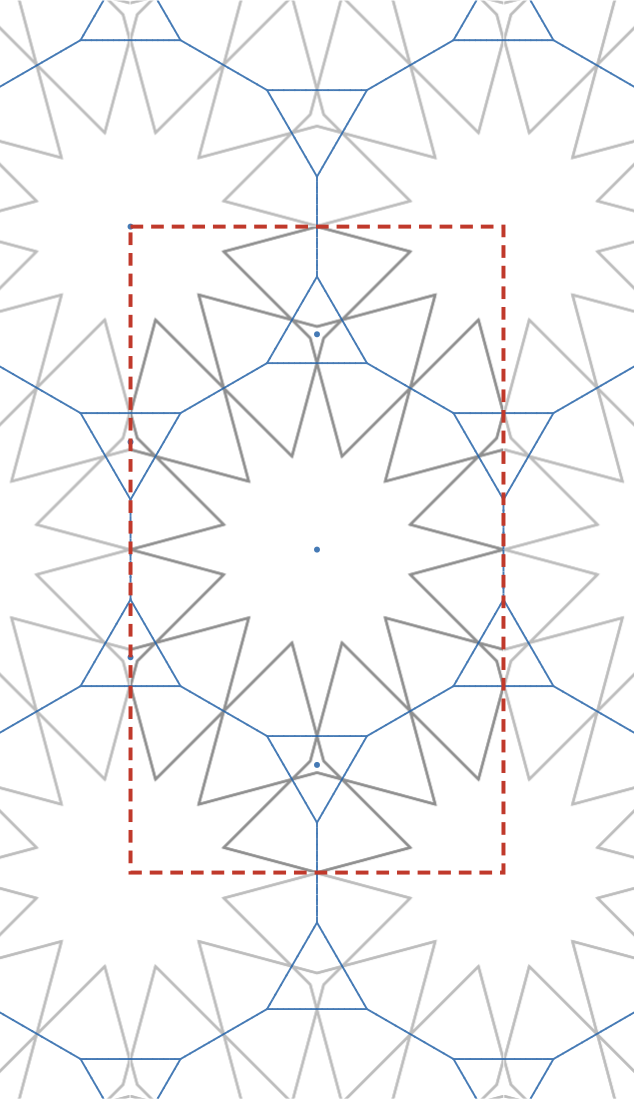
- The motif
- A twelve-point star with sharp, narrow points, drawn inside a twelve-sided shape. Its points land on the middles of the shape's edges.
- The grid
- Twelve-sided shapes that share edges, six around each one, with a small triangle in every gap. Their centers lie on a grid of triangles.
- The petals
- The lines of each star run on past its points into the next shape. Where they cross the lines of the neighboring stars, they make a ring of petals around every star, and a small three-point star in each triangle.
- The repeat
- The smallest tile is a tall rectangle, about 1.7 times as tall as it is wide. It holds two whole rosettes: one in the middle, and one made of the quarters at the corners.
Draw it yourself
- With a compass, draw a circle. Step the same opening around it six times, then halve each arc. Join the twelve marks to make a twelve-sided shape.
- Draw the same shape on every second edge of the first, six times, so each new shape shares an edge with it. Small triangles are left in the gaps.
- Mark the middle of every edge.
- In each twelve-sided shape, join every middle point to the fifth middle point along. The twelve lines make a star with twelve narrow points.
- Carry each line on past the point into the next shape. The crossings make the ring of petals and the small stars in the triangles. Erase the grid and the lines inside each star.
What changes the look
Sharper points give thinner arms and narrower petals; more open points give wider petals. In another layout the rosettes sit among squares and hexagons, with a six-pointed star in each hexagon, so the sheet has two sizes of star. The rosette needs room: use it large, or the petals blur together.
Not the same as
- Girih: Girih also rings its stars with other shapes, but its stars have ten points and sit on a grid of ten-sided shapes.
- Eight-pointed star: Its rosette form also has a star in a ring of petals, but with eight points on a square grid. It reads well at a smaller size.
Twelve points is where Islamic star patterns start to look like flowers. In a rosette the star sits in the middle and a ring of petal shapes surrounds it, so a field of rosettes reads as a garden of large blooms with smaller stars between them. Wikipedia’s Islamic geometric patterns article says craftsmen had moved through a range of six- to thirteen-point patterns by the 13th century.
Dated examples
That article gives two early dates for rosettes of this kind: eight- and twelve-point girih rosette patterns appear in the Alâeddin Mosque at Konya, Turkey, in 1220, and in the Abbasid palace in Baghdad in 1230. The Girih article pictures a twelve-pointed star worked in metal on a gate of the Sultan Hassan mosque in Cairo. Further west, the Alcázar of Seville has a tile pattern built from twelve-, six- and eight-pointed stars, according to the Wikipedia article on zellij.
How craftsmen drew them
According to the Girih article, the first girih patterns were made by copying a template onto a regular grid, and such figures can be drawn with compass and straightedge. It also describes a second method, girih tiles: ready-made tile shapes that carry the lines. On the Darb-i Imam shrine, built in Isfahan in 1453, details of the pattern indicate that these girih tiles were used rather than compass and straightedge. The Topkapı Scroll, a pattern book of the late 15th or early 16th century, holds 114 patterns, including colored designs for girih tilings. The article adds that the idea of one method for all such patterns has been criticized as anachronistic.
Meaning, debated
Our sources do not give the rosette a meaning of its own, and they disagree about meaning in general. Keith Critchlow argues that Islamic patterns are made to lead the viewer to an understanding of an underlying reality. Doris Behrens-Abouseif, against this, sees geometry pursued for its own sake, without religious or moral criteria. The Girih article reports the view that the visible pattern and its hidden tiling form a bridge between the invisible and the visible. We set out the positions and leave the reader to weigh them.
Where you see the twelve-point rosette today
The same article tells how M. C. Escher was inspired by the Alhambra’s decoration to study the mathematics of tessellation, and how researchers have used patterns from Iranian tomb towers to design auxetic materials, which might serve for surgical stents or spacecraft parts. A rosette field also makes a rich coloring page: it has many closed shapes of a few repeated sizes. Give it room. A large print, such as a poster or a journal cover, shows the petals clearly; at a small size they run together.
Sources
- Islamic geometric patterns, English Wikipedia: Konya (1220), Baghdad (1230), the Topkapı Scroll, the debate on meaning, modern uses
- Girih, English Wikipedia: Sultan Hassan gate, Kharraqan, Darb-i Imam, compass and straightedge
- Zellij, English Wikipedia: twelve-, six- and eight-pointed stars in the Alcázar of Seville