Shippo: Meaning and History of the Pattern
Shippo (七宝) is the Japanese pattern of circles that overlap by a quarter, so linked rings and four-petal shapes fill the surface. The chained form is shippo tsunagi. Japanese sources call it auspicious and read the endless chain as peace and harmony; whether the name comes from the Buddhist "seven treasures" is unclear.
Also called: 七宝
The anatomy of the shippo pattern
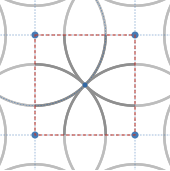
- The motif
- One circle with its center on a corner of a square grid. Its radius is half the diagonal of a square, so it reaches the middle of the four squares around it.
- The grid
- A square grid. Every corner holds the center of a circle, and every circle is the same size.
- The petals
- Where two neighbors overlap, they make a pointed oval across the grid line between them. Four petal tips meet at the middle of each square, and a four-pointed star of ground sits between the petals.
- The repeat
- The smallest tile is one grid square: a quarter of each corner circle, with four half petals that meet in the middle.
Draw it yourself
- Draw a square grid on grid paper or with a ruler and set square.
- Draw the diagonals of one square and mark where they cross. That is the middle of the square.
- Set the compass from a grid corner to the middle of a square next to it.
- Draw a circle with that radius around every corner of the grid. Each circle passes through the middles of the four squares around it.
- Ink the circles, or fill the pointed petals where the circles overlap. Erase the grid.
What changes the look
Open petals give a light net of rings on a plain ground. Filled petals in a second color make the pointed ovals stand out, and small four-pointed stars of ground appear between them. Turn the grid 45 degrees and the chains run on the diagonal. A heavy line suits cutting; a thin one suits stitching guides.
Not the same as
- Seigaiha: Also made of circles, but seigaiha stacks fans of rings in rows that overlap like waves, and only the top of each fan shows. In shippo every circle is whole.
- Asanoha: Asanoha also fills the page with pointed shapes that meet at a point, but they are straight-sided diamonds on a triangle grid, not curved petals on a square grid.
Set circles on a square grid, each one just large enough to reach the middle of the squares around its center. The rings lock together, and between them pointed oval petals appear, four around every crossing. Japanese calls the chained pattern shippō tsunagi, “linked shippō”, and one unit cut from it is simply shippō. Both the Daijisen and Seisen-ban dictionaries define it as a pattern made by joining these units; the Seisen-ban entry describes the units as long ovals with pointed ends, linked together.
Names and a disputed origin
The written name, 七宝, is the word for the “seven treasures” of Buddhist scripture, and the English Wikipedia article on sashiko glosses shippō that way. Japanese Wikipedia is more cautious. It says the link between the pattern and the Buddhist seven treasures is unclear, and that the link with shippō enamel (cloisonné) is unclear too. It records two older names: wachigai, “crossed rings”, and shihō-tasuki, “four-way cross ties”. According to the Japan Family Crest Research Society, shihō (四方, “four directions”) is said to have turned into shippō because the rings spread out on all four sides.
History
Japanese Wikipedia traces the motif to wachigai, a chain pattern of the court textile tradition called yūsoku mon’yō. In the Heian period it served as a kurumamon, the crest on a court carriage. From the Edo period on, a pair of interlocking rings was called wachigai. In family crests a version of the shippō belonged to the Kobori family from the time of Kobori Masakazu, better known as the tea master Kobori Enshū; by tradition, Japanese Wikipedia says, Enshū brought the colors and decoration of cloisonné into the design of tea rooms. The earliest written use of the word for the pattern in the Seisen-ban dictionary is Santo Kanabanashi, a 1781 sharebon, a genre of Edo fiction.
What it means
Japanese Wikipedia calls shippō an auspicious motif that stands for the treasures of the whole world and for endless prosperity of one’s descendants, and it reads the rings that link without end as peace and harmony. Those are the meanings the sources give; we add none of our own.
Where you see shippo today
English Wikipedia lists both shippō and shippō-tsunagi among the common patterns of sashiko, the Japanese running-stitch embroidery. Because it is built from nothing but circles, shippo is also an easy pattern to draw with a compass, to cut from vinyl or to print as a coloring sheet with clear, closed shapes.
For stitching, mark the circles at the size you want and follow them as long curved lines, not one ring at a time. For a coloring sheet, the filled form gives two kinds of shape to color, the petals and the small stars between them.
Sources
- 七宝紋 (Shippo crest and pattern), Japanese Wikipedia: other names, Heian cart crests, stated meanings, the Kobori family
- 七宝繋ぎ, Kotobank (Daijisen, Seisen-ban Nihon Kokugo Daijiten): definition and the earliest citation (1781)
- Sashiko, English Wikipedia: shippō and shippō-tsunagi as common sashiko patterns