Six-pointed star: Meaning and History of the Pattern
The six-pointed star is the hexagram: two equilateral triangles laid over each other. In Islamic geometric art it repeats on a hexagonal grid with hexagons between the stars, and it appears from the 9th century at the Ibn Tulun Mosque in Cairo. In Arabic it is called the Seal of Solomon.
The anatomy of the six-pointed star pattern
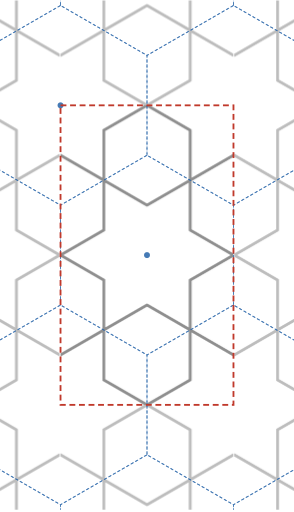
- The motif
- A six-pointed star, the hexagram: two equal triangles laid over each other, one pointing up and one pointing down.
- The grid
- A grid of equal hexagons that share their edges. One star sits inside every hexagon, with its six points on the middles of the hexagon's edges.
- The gaps
- Neighboring stars meet point to point, and their lines cross straight through each meeting point. Where three hexagons meet, a small hexagon is left between three stars.
- The repeat
- The smallest tile is a rectangle about 1.7 hexagon sides wide and 3 sides tall. It holds two whole stars: one in the middle, and one made of the quarters at the corners.
Draw it yourself
- With a compass, draw a circle. Keep the same opening and step it around the circle six times. Join the six marks to make a hexagon.
- Draw the neighbors the same way, so that each new hexagon shares an edge with the first. Fill the page with hexagons.
- Mark the middle of every edge.
- In each hexagon, join every second middle point to make a triangle. Join the other three to make a second triangle, turned upside down.
- Erase the lines inside each star and the hexagon grid. The stars now touch point to point, with a small hexagon between every three.
What changes the look
Regular points give straight, even arms. Blunter points make the arms wider, and the shapes between the stars grow into broad petals. In another layout the stars stand apart, each ringed by six hexagons with small triangles between them, so the stars sit in a lattice. One color reads as lines that cross; two colors bring out the stars.
Not the same as
- Asanoha: Asanoha also has six points around a center, but each point is a thin diamond, and the stars share their diamonds on a grid of triangles.
- Eight-pointed star: Two squares instead of two triangles, on a square grid, so the stars have eight points and leave crosses between them.
Take two equilateral triangles, turn one upside down and lay it over the other: their points make a six-pointed star, and where they overlap there is a regular hexagon. That figure, the hexagram, is the simplest of the star shapes in Islamic geometric art, and English Wikipedia’s hexagram article gives the classic way to draw it. Draw a circle, walk the compass around the rim using the same radius to mark six points, then join every other point.
Names
In Arabic, the hexagram article says, the figure is called Khātem Sulaymān, the Seal of Solomon, or Najmat Dāwūd, the Star of David, though the name Seal of Solomon is also used for a five-pointed star. The same article notes that the legend of Solomon’s seal gave the ring power over demons (shedim) and jinn.
Where it appears
Wikipedia’s article on Islamic geometric patterns dates patterns of six- and eight-point stars to 879, at the Ibn Tulun Mosque in Cairo, and abstract six- and eight-point shapes to 1067, in the tower of Kharraqan near Qazvin in Persia. It describes the decoration of a 15th-century mosque in Yazd as built from a circle, with a six-pointed star surrounded by six smaller irregular hexagons.
The star also shows up outside pure pattern. The hexagram article illustrates it on an 11th-century coin from Sicily and a coin struck in Aleppo in 1204, on Humayun’s Tomb in Delhi from the late 16th century, and on the minaret of the Arasta Mosque in Prizren. The medieval Karamanid and Jandarid beyliks of Anatolia put it on their flags. In Seville, the Alcázar has a tile pattern that combines twelve-, six- and eight-pointed stars, according to the Wikipedia article on zellij.
Does it mean anything?
None of our sources gives the six-pointed star a fixed meaning inside Islamic geometric patterns. The broader debate is covered in the Islamic geometric patterns article: Keith Critchlow argues that the patterns lead the viewer toward an understanding of an underlying reality, while Doris Behrens-Abouseif sees geometry used for its own sake, without religious or moral criteria. We present both views and take neither.
How to use the six-pointed star
The hexagon grid packs tightly, so the star works as a dense all-over print, a tile design or a coloring page with many closed shapes. In one color it reads as an interlace of lines; filling stars and hexagons in two colors brings out the stars.
It is also the easiest Islamic star to draw by hand. The Wikipedia article on Islamic geometric patterns says many of them are drawn on grids that need only a ruler and compass, and this star needs nothing more than a compass, a ruler and a grid of hexagons.
Sources
- Hexagram, English Wikipedia: names, the compass construction, the star on coins, tombs and flags
- Islamic geometric patterns, English Wikipedia: Ibn Tulun (879), Kharraqan (1067), the Yazd mosque, ruler and compass
- Zellij, English Wikipedia: six-pointed stars in the Alcázar of Seville