Girih Tiles: The Five Shapes Behind Islamic Stars
Girih are the star-and-polygon strapwork patterns of Persian and Islamic tilework. Five tile shapes carry the lines, which cross every tile edge at its midpoint and join into ten-point stars.
Also called: girih tiles
The anatomy of the girih pattern
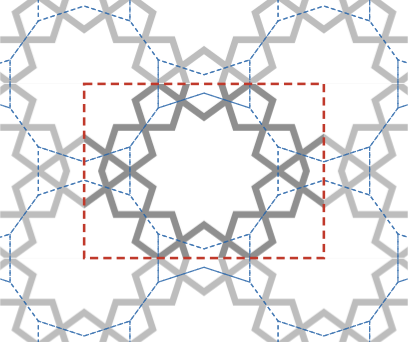
- The motif
- A ten-point star inside a ten-sided shape, the decagon, with a ring of pentagons around it.
- The grid
- Decagons that each share an edge with four neighbors. Their centers lie on a grid of slanted rhombi with angles of 72 and 108 degrees.
- The gaps
- Between the decagons are bowties: six equal sides, with angles of 72, 72 and 216 degrees, twice over.
- The lines
- Two lines cross the middle of every edge, each at 54 degrees to it, and run on until they meet the lines from the next edge. Only these lines show. The decagon and bowtie edges stay hidden.
- The repeat
- The smallest tile is a rectangle about 1.6 by 1.2 times the distance between the centers of two touching decagons, with one decagon in the middle and one at the corners.
Draw it yourself
- Draw a circle. With a protractor, mark ten points 36 degrees apart, and join them to make a decagon.
- Copy the decagon across four of its edges: share one edge, skip one, share one, skip two, share one, skip one, share one, skip two. The gaps between the decagons are bowties.
- Mark the middle of every edge, on the decagons and the bowties alike.
- At each middle, draw two short lines that cross in an X, each at 54 degrees to the edge.
- Run each line on until it meets a line from the next edge. In each decagon the lines close into a ten-point star ringed by pentagons.
- Erase the decagons and bowties, so only the lines are left.
What changes the look
A smaller crossing angle gives wider stars and smaller pentagons; a larger one gives sharp stars with kites around them. Wide bands look bold and narrow ones look fine. Bands that pass over and under each other look woven. Thin tile edges in place of bands look like the drawings of the Topkapı Scroll, and petals around each star give a rosette.
Not the same as
- Twelve-point rosette: Also a star in a ring of other shapes, but with twelve points, set on twelve-sided shapes with triangles between them.
- Eight-pointed star: A simpler star of eight points made of two squares, on a square grid, with crosses between the stars.
Girih means “knot” in Persian. The term names the interlaced strapwork of Islamic tessellation, drawn on five polygon shapes, the girih tiles, used from about 1200, according to Wikipedia’s Girih tiles article.
What does girih mean?
Girih (also gereh) is Persian for “knot”, Wikipedia’s Girih tiles article says. It names the crossing lines rather than the tiles beneath. Usually only the girih and minor ornament like flowers show, while tile edges stay hidden. A decagon can hold two girih layouts, one with only fivefold symmetry instead of tenfold.
The five girih tiles
Wikipedia’s Girih tiles article lists five equal-sided shapes with their Persian names: regular decagon (tabl), elongated hexagon (shesh band), bowtie (sormeh dan), rhombus (torange), and regular pentagon (pange). All angles are multiples of 36°: decagon 144°; elongated hexagon 2 × [72°, 144°, 144°]; bowtie 2 × [72°, 72°, 216°]; rhombus 2 × [72°, 108°]; pentagon 108°. Two intersecting lines cross each edge’s center at 54°, joining across tiles into a continuous girih pattern.
Where girih came from
Wikipedia’s Girih article says girih is thought to draw on 2nd-century AD Syrian Roman knotwork. Start dates disagree: it puts the earliest girih around 1000 CE, while Wikipedia’s Strapwork article says Islamic girih dates from the 8th century onward. The Girih article cites a Baghdad Quran frontispiece from 1000 as the earliest book example, interlaced stucco panels at the Kharraqan towers (1067), and straight-strap patterns on the Ribat-i Malik caravanserai gateway in Uzbekistan (1078).
Later dates disagree too. The Girih article dates 5- and 10-fold girih from as early as the 13th century, while Wikipedia’s article on geometric Islamic patterns notes 7- and 10-point girih at Isfahan’s Jameh Mosque in 1086. The Girih article says the craft flourished until the 15th century; the geometric-patterns article records girih strapwork surfaces from the 15th to the 20th century.
The Darb-i Imam and the Topkapı Scroll
The first building of Isfahan’s Darb-i Imam imamzadeh shrine was built in 1453 under the Qara Qoyunlu, Wikipedia’s Darb-e Imam article states. Wikipedia’s Girih article notes its spandrel uses only decagons and bowties, showing tile use rather than compass drafting. The shrine and the Topkapı Scroll come up again in the history of the twelve-point rosette. Found in 1986 without text, signature, or date, the 33 cm by 29.5 m scroll holds 114 ink-and-dye patterns (Wikipedia’s Topkapı Scroll article) alongside their tilings (the Girih article). It dates to late 15th- or early 16th-century Iran, though articles differ: the scroll article’s History calls it presumably Safavid, while its lead and the geometric-patterns article say late 15th-century Timurid Iran.
Are girih tiles quasicrystals?
In Science (2007), Lu and Steinhardt suggested girih tilings have properties consistent with self-similar quasicrystalline tilings like Penrose tilings, Wikipedia’s Girih tiles article reports; Wikipedia’s Darb-e Imam article adds that Peter Lu found the shrine’s tiles strongly resemble Penrose tilings. Critics in Wikipedia’s Girih article note no evidence that medieval artisans subdivided tiles into Penrose kites and darts, and no known design exceeds two levels; Makovicky argues artisans were satisfied with a large fundamental domain instead of endless quasi-periodic patterns. The Girih tiles article notes the general view of straightedge-and-compass drafting, while the Girih article adds that assuming one universal method has been called anachronistic.
Girih, strapwork and interlace
Wikipedia’s article on geometric Islamic patterns notes that girih straps typically seem to weave over and under each other, and that the visible strapwork does not follow the tiling’s hidden construction lines. The tile edges stay hidden, so in this Islamic geometry only the bands show.
How to use girih
Girih works best where its lines can run on without a break: a wall panel, a door, a screen or a book cover. The same bowtie gaps shape the ten-point jali screens. For girih to print, color or cut, with more on strapwork and interlace, see Islamic patterns.
Girih rewards a large size. The lines are the design, so pick a band wide enough to see from across a room, and give the stars at least a hand’s width each.
Sources
- Girih tiles, English Wikipedia: the five tiles, 54°, Lu and Steinhardt
- Girih, English Wikipedia: early examples, Darb-i Imam, the critics
- Topkapı Scroll, English Wikipedia
- Darb-e Imam, English Wikipedia