Ichimatsu: Meaning and History of the Pattern
Ichimatsu (市松模様) is the Japanese name for the checkerboard: squares of two colors in alternation. It is named after the 18th-century kabuki actor Sanogawa Ichimatsu, but the pattern itself appears on haniwa figures and in 7th–8th-century textiles at Hōryūji and the Shōsōin. It was the basis of the Tokyo 2020 emblem.
Also called: 市松
The anatomy of the ichimatsu pattern
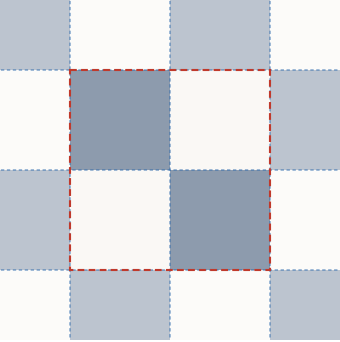
- The motif
- A plain square. Japanese sources also allow a rectangle.
- The grid
- A square grid. The colors change at every square along each row and each column, so no two squares of one color share an edge.
- The diagonals
- Squares of one color touch only at their corners. They line up on the diagonals, which gives the check its movement.
- The repeat
- The smallest tile is two squares by two: two dark squares on one diagonal, two light ones on the other. Copies of it, side by side and one under the other, fill any surface.
Draw it yourself
- On grid paper, or with a ruler, draw a square grid: lines the same distance apart in both directions.
- In the top row, color the first square, skip one, color the next, and go on to the end of the row.
- In the second row, start one square later, so each colored square sits under a plain one.
- Repeat row by row. Check that no two colored squares share an edge.
What changes the look
The size of the squares sets the scale: a small check reads as a texture, large squares as a bold graphic. Turn the grid 45 degrees for the diamond check. Strong contrast, such as black and white, looks crisp and lively; two close shades give a calm, woven look. Swap the two colors to make a light sheet dark.
Not the same as
Ichimatsu is about as plain as a pattern can be. Two colors of square alternate like the board of a game of checkers; Japanese Wikipedia allows rectangles as well as squares. The Heibonsha World Encyclopedia calls it one of the simplest geometric motifs, found in many cultures. What is Japanese about it is mostly the name.
Older names
Before it was ichimatsu the pattern was ishidatami, “paving stones”, for its likeness to a stone pavement. In the court tradition of the Heian period it was called arare, “hail”, Japanese Wikipedia says. Later names include ichimatsu-gōshi and Genroku moyō. Daijisen lists ishidatami, arare and ichimatsu mon’yō as other words for the same thing, and Mypedia gives black and white, or black and red, as its usual colors. Japanese Wikipedia also lists a diamond check, with the squares turned 45 degrees, among the forms of ishidatami.
The actor in the checked hakama
Sanogawa Ichimatsu was an 18th-century kabuki actor, born in 1722 in Fushimi, who settled in Edo in 1744 and died in 1762, according to English Wikipedia. Japanese Wikipedia tells the story behind the name: at the Nakamura-za theater in Edo he wore a hakama of alternating white and dark blue squares in the play Shinjū Mannensō, and women copied it on their kosode robes. The Heibonsha encyclopedia dates the naming to 1741 and names his role in Kōya Shinjū. Both sources present the story as tradition, with an “it is said”. After his death, a memorial performance at the Morita-za in 1763 carried the old name of the pattern, ishidatami, in its title.
Much older than the name
The squares are far older than the actor. Japanese Wikipedia points to the clothing of haniwa clay figures from the Kofun period, including finds from a haniwa kiln site in Saitama, and to textiles kept at Hōryūji and the Shōsōin. The Heibonsha encyclopedia dates those textiles to the 7th and 8th centuries. None of our sources gives ichimatsu a symbolic meaning, and we don’t invent one.
Where you see ichimatsu today
The pattern had a very public moment when Tokyo hosted the 2020 Olympic and Paralympic Games. Japanese Wikipedia says the emblem, by the artist Asao Tokolo, was a design called kumi ichimatsu mon, and that the mascots Miraitowa and Someity used a similar design. In 2021 the Japan Patent Office refused Shueisha’s application to register the checked pattern from Demon Slayer as a trademark. The same article mentions the transparency grid in Photoshop and a garden at Tōfukuji by Shigemori Mirei.
Two colors and straight edges keep the check crisp at any size, in print and on screen. It is also the easiest pattern to line up by hand: fold or cut along a row of squares and the check stays continuous across the seam.
Sources
- 市松模様 (Ichimatsu pattern), Japanese Wikipedia: other names, the actor, early examples and modern uses
- 市松模様, Kotobank (Daijisen, Seisen-ban, Heibonsha World Encyclopedia, Mypedia): the 1741 naming and the 7th–8th-century textiles
- Sanogawa Ichimatsu, English Wikipedia: the actor's dates only