Uroko: Meaning and History of the Pattern
Uroko (鱗文, "scales") is the Japanese pattern of triangles in rows, alternately light and dark, read as the scales of a fish or a snake. It appears on haniwa and tomb paintings, was long held to ward off evil, and gave the Hōjō clan its crest of three scales.
Also called: 鱗
The anatomy of the uroko pattern
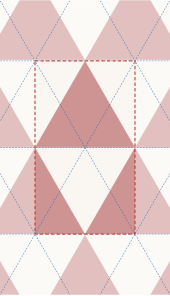
- The motif
- One equilateral triangle, with one side flat and its point up, in the pattern color.
- The grid
- A grid of equal triangles with one side flat. Each row has triangles that point up and down in turn, and each row moves half a side from the row above.
- The ground
- Every triangle that points up is filled, and every triangle that points down is left plain. The filled triangles touch only at their corners.
- The repeat
- The smallest tile is one side wide and two rows tall. Only two colors are needed.
Draw it yourself
- Draw level lines, all the same distance apart.
- On the first line, mark points one side apart. On the next line, mark them again, moved half a side. Do the same on every line.
- Check one triangle with a compass: the distance from each point to the two nearest points on the next line must be one side. If it is too short or too long, change the space between the lines.
- Join each point to the two nearest points on the line above and the line below. You now have a grid of triangles.
- Fill in every triangle that points up. Leave the triangles that point down as ground.
What changes the look
Only size, color and direction change the look. With the points upright the rows read as a stack of peaks. Turn the pattern on its side and the rows become a sawtooth band. Strong contrast, such as gold on charcoal, looks bold; a pale color on white looks light and crisp.
Not the same as
- Ichimatsu: Also two colors that take turns, but ichimatsu uses squares that meet along whole edges. Uroko uses triangles that meet only at their corners.
- Seigaiha: Greek, Roman and West Asian art has a scale pattern of half circles that overlap. It is closer to the rings of seigaiha than to the triangles of uroko.
Uroko means “scales”. The pattern is nothing but triangles: rows of them, pointing up and down in turn, half of them dark and half light. Japanese Wikipedia describes it as triangles set in a regular order and likened to the scales of fish or snakes; Daijisen specifies isosceles or equilateral triangles joined up, down and sideways.
Very old, and never quite gone
The Heibonsha World Encyclopedia says the triangle scale pattern is very old and found all over the world. In Japan, Nipponica notes, it is common on haniwa clay figures and in the wall paintings of Kofun-period tombs, drawn in red or blue, and some scholars see it as a symbol of an early belief. Nipponica follows its fortunes: from the Nara to the Kamakura period it faded, showing up mostly on the clothes of ordinary people in picture scrolls, then came back in the Muromachi period on precious imported fabrics (meibutsu-gire). After that it appeared on jinbaori, the surcoats worn over armor, and on Noh costumes.
Snakes, demons and the stage
Japanese Wikipedia says the pattern has long been held to ward off evil, and lists it on court dress, arms and armor, Noh costume and the buildings of shrines and temples. In Noh and kabuki it sometimes marks a demon woman or a woman who is really a serpent. Nipponica names the technique for that role: urokohaku, scales printed in gold or silver leaf, on the costume of the snake-bodied female role. In the Edo period it was also well known as a kabuki costume.
Three scales for the Hōjō
The best-known uroko is a crest. English Wikipedia’s article on the Hōjō clan tells the legend: Hōjō Tokimasa prayed, the goddess Benzaiten is said to have appeared to him, and after this the Hōjō took three scales as their mon. Japanese Wikipedia tells the same story with Benzaiten turning into a snake and leaving three scales behind, and says the scale crests of the Hōjō and Ogata families are thought to come from snake legends. Its crest forms run from hitotsu uroko, a single triangle, to mitsu uroko, three triangles stacked into a peak, and on to six-scale and five-scale wheel forms.
The Heibonsha encyclopedia adds a caution about the word: Greek, Roman and West Asian art has a different scale pattern made of overlapping half circles. In Japanese design, uroko means the triangles.
Where you see uroko today
English Wikipedia lists uroko among the common patterns of sashiko stitching. Its hard straight edges also suit cut vinyl, stencils and laser engraving.
Because it needs only two colors and has no thin lines, uroko stays clear at a small size on a screen and at a large size on a poster. A single row of triangles makes a simple border for a card, a book spine or the hem of a costume.
Sources
- 鱗文様 (Uroko pattern), Japanese Wikipedia: definition, protective meaning, costume use
- 鱗 (Scale), Japanese Wikipedia: stage roles, the Hōjō legend, crest forms
- 鱗文, Kotobank (Nipponica, Daijisen, Heibonsha World Encyclopedia): haniwa and tomb paintings, decline and return, Noh costume
- Hōjō clan, English Wikipedia: the legend of the three scales
- Sashiko, English Wikipedia: uroko as a sashiko pattern