Kikko: Meaning and History of the Pattern
Kikko (亀甲, "tortoise shell") is the Japanese hexagon pattern: six-sided cells joined edge to edge like the plates of a turtle's shell. Japanese Wikipedia says it stands for long life and good fortune and that examples survive among the Nara-period treasures of the Shōsōin.
Also called: 亀甲
The anatomy of the kikko pattern
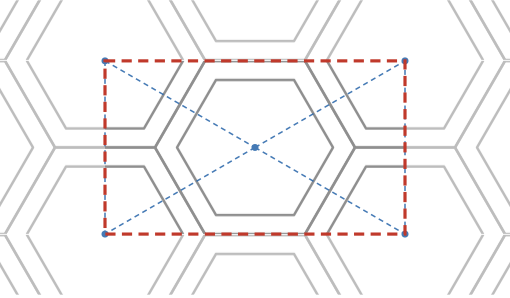
- The motif
- A regular hexagon with a second, smaller hexagon inside it on the same center: a double outline.
- The grid
- Hexagons with a flat top and bottom, joined edge to edge. Each one touches six others and no gaps are left. Their centers form a grid of triangles.
- The band
- The space between the outer and the inner outline. A narrow band reads as a double line; a wide one leaves a small cell floating in the middle.
- The repeat
- The smallest tile is three hexagon sides wide and about 1.7 sides tall: one whole hexagon in the middle and a quarter of one at each corner. Copies of it, side by side and one under the other, fill any surface.
Draw it yourself
- With a compass, draw a circle. Keep the same radius and step it six times around the rim. Join the six marks: a hexagon whose sides equal the radius.
- Turn the paper so the hexagon has a flat top. Draw its neighbors on its edges, each with the same side, until the surface is full. Three hexagons meet at every corner.
- In each hexagon, lightly join the center to the six corners. Mark a point the same distance in from each corner and join the marks: this is the inner hexagon.
- Erase the light lines. Leave the band between the two outlines plain, or fill the inner cells with a second color.
What changes the look
The width of the band sets the mood: narrow for a fine double line, wide for a small cell that can hold a color or a motif. A thick outer line reads as a bold print, a thin one as a quiet texture. Group the hexagons in threes, with a heavy line round each group, for a larger three-lobed figure.
Not the same as
- Asanoha: lines through each hexagon make six-pointed stars of thin diamonds.
- Six-pointed star: a star fills each hexagon, and the hexagon edges do not show.
Kikko is the honeycomb of Japanese design, though the Japanese name points to a different animal. 亀甲 means the shell of a turtle or tortoise; the Japanese Wikipedia article on the word gives the readings kikkō, kikō and kame no kō. The pattern article on the same site defines kikkō mon’yō as one of Japan’s traditional geometric patterns, made of hexagons set one after another, and explains it as a stylized turtle shell.
Hexagons since the Nara period
According to Japanese Wikipedia, examples of the pattern are found among the Nara-period treasures of the Shōsōin repository. From there it spread to clothing and other textiles, to lacquerware and to ceramics. The Seisen-ban Japanese dictionary defines the pattern sense of the word as hexagons joined above and below, left and right, and its oldest quotation for that sense comes from Inaka Shibai, a 1787 piece of Edo fiction that mentions a velvet garment with a kikko design.
A sign of long life
Japanese Wikipedia says the pattern symbolizes long life and good fortune. That is the whole of what our sources state about its meaning, so we leave it there. The turtle connection is in the name itself.
Crests and other forms
Kikko is also a family-crest shape. Daijisen describes the crest as modeled on a turtle’s shell, and the Seisen-ban dictionary says such crests are mostly a hexagon or a combination of hexagons, naming forms such as kikkō-kuzushi, “broken tortoise shell”, and mitsuwari kikkō hanabishi. Japanese Wikipedia lists other forms such as karahana kikkō and kikkō ni tsuru, a crane in a hexagon. It says the pattern is still used in kimono, in family crests and in design today.
How to use kikko
Because every cell is the same size, kikko is a calm background that takes a motif well, much as the crane in kikkō ni tsuru sits inside its frame. Thick outlines read as a bold geometric print; thin double outlines give a finer, quieter texture. On a coloring sheet the honeycomb gives many small, equal spaces to fill.
Pick the inner outline to suit the job. When the two lines sit close, the honeycomb looks finely drawn and stays light on the page. When they sit far apart, each cell gets a small hexagon of its own that can take a second color, a sticker or a stamp. For a bolder figure, choose hexagons grouped in threes: a heavy line around each group and a light line inside it make larger three-lobed shapes on the same honeycomb.
Sources
- 亀甲文様 (Kikko pattern), Japanese Wikipedia: definition, Shōsōin examples, meaning, other forms and uses
- 亀甲 (Tortoise shell), Japanese Wikipedia: readings of the word
- 亀甲, Kotobank (Daijisen, Seisen-ban Nihon Kokugo Daijiten): the pattern and crest senses; the earliest citation (1787)