Seigaiha: Meaning of the Japanese Wave Pattern
Seigaiha (青海波, "blue ocean waves") is the Japanese pattern of overlapping fans of rings that reads as rows of waves. It takes its name from a court dance whose costume carried it, and Japanese reference works call it an auspicious motif used since the Nara period.
Also called: blue ocean waves · 青海波
The anatomy of the seigaiha pattern
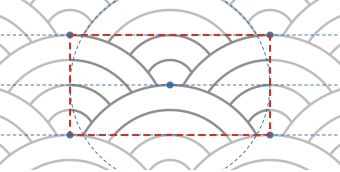
- The motif
- A fan of three to five rings, one inside the other, around one center.
- The grid
- The fans of one row sit side by side and touch. The next row moves half a fan to the side, so each fan sits in the gap between two fans above it.
- The overlap
- The rows are half a ring's radius apart, and each row lies over the one above it. Only the top of each fan shows, and this gives the wave edge.
- The repeat
- The smallest tile is one fan wide and two rows tall. Copies of it, side by side and one under the other, fill any surface.
Draw it yourself
- Draw a straight row of points, each two radii apart. With a compass, draw a circle of that radius around each point. The circles touch.
- Inside each circle, draw smaller circles on the same center, in even steps: for example three quarters, one half and one quarter of the radius.
- Draw the next row half a radius lower. Move each center one radius to the side, so it sits between two centers of the row above.
- Erase the lines of the row above that fall inside the outer circles of the new row.
- Repeat row by row. Each new row covers the bottom of the row above it.
What changes the look
The number of rings sets the mood. Three rings give wide, open bands; five give a fine stripe that reads as texture. A heavier line keeps the rings clear on a dark ground. Turn the tile a quarter and the waves climb in columns, not rows.
Not the same as
Seigaiha is the wave pattern most people picture when they think of Japanese design: stacked fans of rings, each row tucked behind the one in front, so the whole surface rolls like a calm sea. The name is written 青海波, “blue sea waves”, and Japanese Wikipedia describes the pattern as a geometric rendering of the wave crests you see on the surface of the sea.
A name borrowed from a dance
Seigaiha is also the name of a piece of gagaku, the old court music of Japan. It is a tōgaku piece in the banshiki mode, danced by two performers of the left side, and it is famous for its scene in the “Autumn Excursion” (Momiji no Ga) chapter of The Tale of Genji. The wave pattern on the dancers’ costume is said to have given the design its name; both Japanese Wikipedia and the Daijisen dictionary hedge that with “it is said”. Where the dance name itself comes from is less settled. The Nipponica encyclopedia ties it to Qinghai (青海) in China, while the Heibonsha World Encyclopedia says only that Seigaiha and its companion dance Rintai are thought to be place names of the Western Regions.
How old the pattern is
Nipponica calls seigaiha an auspicious (kichijō) motif in use since the Nara period. The Heibonsha encyclopedia points to earlier traces: the collars of haniwa clay figures, and the printed sea pattern on the formal skirt of the jūnihitoe, the layered court dress of women. It adds that nobody is sure whether the design began as a stylized picture of big waves.
In the Edo period a lacquerer known as Seigai Kanshichi became famous for painting it. Japanese Wikipedia says he drew it skillfully with a special brush in the mid-Edo period and that this spread the pattern widely; Nipponica places him in the Genroku era and says he painted the waves in black lacquer. Heibonsha goes a step further and suggests he took the name Seigai for himself from the pattern, not the other way round.
Three descriptions of one shape
The reference works do not agree on how to describe the figure. Japanese Wikipedia says semicircles are layered three deep and repeated like waves. Daijisen calls it semicircles stacked as concentric rings. Nipponica describes ginkgo-leaf shaped waves repeated at 45 degrees to the left and right. All three fit the same picture: arcs that nest inside each other and overlap row by row.
Where you see seigaiha today
Mypedia notes that the pattern is widely used on clothing as an auspicious design. Because the rows read clearly at any size, seigaiha works as a small all-over print on paper and fabric and as a large, bold background. Two colors give the classic look; three or four colors let alternate rings change shade.
Sources
- 青海波 (Seigaiha), Japanese Wikipedia: the dance, the costume, the name and Seigai Kanshichi
- 青海波, Kotobank (Nipponica, Heibonsha World Encyclopedia, Daijisen, Mypedia): early examples, the auspicious sense and the three descriptions of its shape