Asanoha: Meaning and History of the Pattern
Asanoha (麻の葉, "hemp leaf") is a six-pointed star of thin diamonds repeated on a triangle grid. It was put on babies' clothes in the hope that the child would grow as straight and fast as hemp, and it has decorated Buddhist images since the Heian period.
Also called: 麻の葉
The anatomy of the asanoha pattern
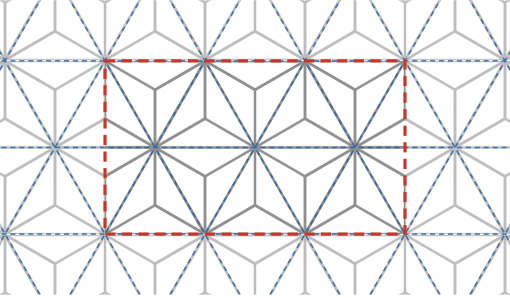
- The motif
- A six-pointed star made of six long, narrow diamonds that meet at one point, like the spread leaf of a hemp plant.
- The grid
- A grid of equilateral triangles. A line from the center of each triangle to each of its three corners splits it into three thin triangles.
- The shared diamonds
- Each diamond is two thin triangles back to back across one grid line, so every point of the grid sits in the middle of a star, and next stars share their diamonds. Color the thin triangles that ring every third point and one star in three stands out.
- The repeat
- The smallest tile is three triangle sides wide and two rows of triangles tall. Copies of it, side by side and one under the other, fill any surface.
Draw it yourself
- Draw level lines the same distance apart. Mark points one side apart on each line, and move the marks half a side along on every second line.
- Join each mark to the two nearest marks on the line below. This gives a grid of equilateral triangles.
- Find the center of each triangle: lightly draw lines from two corners to the middle of the opposite sides and mark where they cross.
- Join the center of each triangle to its three corners, then erase the light lines.
- Around any point where six triangles meet, the lines now make six thin diamonds: the hemp-leaf star.
What changes the look
Open lines give a light lace that sits well behind words. Filling the thin triangles around every third star in a second color gives the bolder two-tone look, with a clear star at each filled ring. A fine line turns gray from a distance, so pick a heavier line for small prints.
Not the same as
- Kikko: plain hexagons, with no lines running through their centers.
- Six-pointed star: a star of two overlapping triangles on a hexagon grid, not a star of diamonds.
Asanoha means “hemp leaf”. Look at the pattern from a step back and every point where lines meet becomes a little star of six narrow diamonds, a bit like the spread leaf of the hemp plant. The Japanese name was given in the early modern period because of that likeness, Japanese Wikipedia says. The Seisen-ban Japanese dictionary describes the figure as six rhombuses set together in a hexagon, and Japanese Wikipedia notes that the basic form is the regular hexagon, with many other forms built on it, including some with leaf-shaped parts.
From Buddhist statues to the kabuki stage
The design is much older than its name. Japanese Wikipedia records it in kirikane, the cut gold leaf laid on Heian-period Buddhist statues. From the early Kamakura period, mainly in the 13th and 14th centuries, it appears on the robes of Buddhist images, above all esoteric figures, and on the grounds of mandalas; one example given is a mandala of the Prajñā bodhisattva from the Nanboku-chō period. In the Muromachi period the motif grew larger.
Then it moved into fashion. In 1809 the actor Iwai Hanshirō V played the greengrocer’s daughter Yaoya Oshichi in an asanoha costume of kanoko tie-dye, a look people called “Hanshirō’s kanoko”. In Osaka, during the Bunsei era (1818–1830), Arashi Rikan wore it in the role of Osome. The Seisen-ban dictionary says the pattern was popular with women in Kyoto and Osaka around the Bunka and Bunsei eras (1804–1830), and Japanese Wikipedia adds that it was common in Edo ukiyo-e prints.
Hokusai explained how to draw it in his Hokusai Manga, and his pattern book Shingata Komon-chō gives twelve variations.
A wish for children
Hemp grows straight and quickly. Both sources link that to the custom of dressing newborns in asanoha: the Seisen-ban dictionary says it was used for babies’ first clothes and underwear in the hope that the child would take after the straight-growing hemp. Japanese Wikipedia adds wishes for health and long life, the belief that hemp keeps insects away, and the use of the pattern in semamori, protective stitching on the back of children’s clothes. It also notes that some explain that protective power by the geometric shape and others by a Buddhist origin.
Where you see asanoha today
Japanese Wikipedia lists the pattern in family crests and shrine crests, such as that of Ōasahiko Shrine in Tokushima, in Hakone marquetry (yosegi-zaiku), in kimono and in general design. It became a talking point again when the publisher Shueisha applied to register the asanoha design used in Demon Slayer as a trademark; the application was refused. The fine, even lines make asanoha a natural line drawing for coloring and stitching, and it holds up well in a single color.
Sources
- 麻の葉文様 (Asanoha pattern), Japanese Wikipedia: Buddhist use, kabuki actors, Hokusai, crests and the trademark case
- 麻の葉, Kotobank (Daijisen, Seisen-ban Nihon Kokugo Daijiten): six diamonds in a hexagon; the Bunka–Bunsei fashion and babies' clothes