Paisley: Meaning and History of the Boteh
Paisley is the English name of the boteh, a teardrop with a curved tip. It came to Europe on Kashmir shawls and took its name from a Scottish weaving town.
Also called: boteh, buta
The anatomy of the paisley pattern
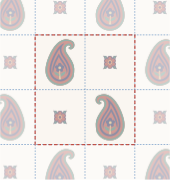
- The motif
- The boteh: a teardrop with a round base and a tip that bends over to one side. Inside it, smaller outlines follow the edge, around a small flower on a stem.
- The grid
- Rectangles a little taller than they are wide. The botehs sit in every second cell, like the dark squares of a checkerboard, so each row is shifted half a step from the next.
- The turn
- Every second row is mirrored, so its tips bend the other way, as on Sarabend rugs.
- The flowers
- A small flower fills each cell that has no boteh.
- The repeat
- The smallest tile is two cells wide and two cells tall: two botehs, one of them mirrored, and two flowers.
Draw it yourself
- On grid paper, draw a grid of rectangles a little taller than they are wide.
- Mark the cells in pencil like a checkerboard. The botehs go in the marked cells and the flowers in the others.
- Draw one boteh in a marked cell: a teardrop with a round base and its tip bent over to one side. Inside it, draw two or three smaller outlines that follow the edge, and a small flower near the base.
- Copy the boteh into every marked cell of that row. In the next row, draw it mirrored, so the tip bends the other way.
- Draw a small flower in each empty cell, then erase the grid.
What changes the look
A large boteh, tilted, with layered insides and a beaded edge, looks rich and formal. Small botehs in closer rows give the closest bandana look, best in three colors or black outlines on white. Tilt all the botehs one way, face every row the same way and swap colors on alternate rows, and the pattern reads as diagonal lines. Leave out the flowers for a simpler, more open sheet.
Paisley is the English name of the boteh, a textile design using a teardrop shape with a curved upper end, as Wikipedia’s article on paisley describes it. The paisley meaning starts with its names. The Persian name is boteh jegheh, meaning “ancient motif,” and in Persian boteh translates as shrub or bush. In Kashmir it was called buta or bu, while in Hindi and Urdu kairi means unripe mango.
Paisley meaning
Wikipedia’s article on paisley notes that the boteh’s origins and symbolism remain speculation, with experts disagreeing on when it emerged. Some argue it could symbolize the sun, a phoenix, or an ancient Iranian religious sign for an eagle, while the regional names point to a shrub or bush in Persian and an unripe mango in Hindi and Urdu. Wikipedia’s article on Kashmir shawls adds that French cachemire names the teardrop itself, and cashmere wool is named after Kashmir.
The paisley article also notes that a related Iranian boteh floral pattern marked elite status and mostly decorated royal objects; traditionally, the pattern was woven onto silk clothing with silver and gold thread.
Where does paisley come from?
The two Wikipedia articles disagree on paisley origin: Persian paisley or Indian paisley. Wikipedia’s article on paisley describes the design as Iranian or Persian in origin, whereas Wikipedia’s Kashmir shawl article states that it originates in the Indian buta.
Wikipedia’s paisley article points to the Noh Gumbad mosque in Balkh, Afghanistan, as the earliest believed evidence in Islamic culture, possibly as early as the 800s. In early Iran, the boteh was woven into Termeh, a very valuable cloth, and was common on nobles’ khalat robes; the article states it was carried from Persia to Kashmir in the 1400s.
Early dates in paisley history also diverge: Wikipedia’s paisley article puts some of the earliest recorded Kashmir shawls in the 1400s, while Wikipedia’s Kashmir shawl article dates the earliest mentions of a shawl-weaving industry to the 11th century, adding that Babur founded the Mughal Empire in 1526 and his grandson Akbar conquered Kashmir in 1586.
Kashmir shawls
Wikipedia’s paisley article notes that Akbar wore two shawls at once as a status symbol and gave shawls as gifts. According to Wikipedia’s Kashmir shawl article, the Kani weave’s discontinuous-weft technique made complex patterns like the buta possible. A patterned shawl could take up to 18 months to make, so nobles mostly wore them; in India, men wore the shawl, its fineness showing nobility or royal favor.
The Kashmir shawl article adds that Safavid, Zand, and Qajar rulers of Iran wore Kashmir shawl cloth and gave Kashmir shawls as robes of honor. Empress Josephine first wrote of the shawls, “I find them hideous,” yet later owned three or four hundred; she and Queen Victoria made the shawl a sign of exotic luxury.
How a Scottish town gave paisley its name
Wikipedia’s paisley article says the British East India Company brought Kashmir shawls from India to England and Scotland in the 18th and 19th centuries. Westerners initially called the boteh “pine and cone.” The English name came from Paisley in west Scotland, where weavers reproduced the designs on Jacquard looms.
From about 1800 to 1850, Paisley weavers led shawl production, using five colors where most used two and reaching 15 by 1860, the same article reports. The sources disagree again: Wikipedia’s paisley article calls Paisley the first Western place to imitate the design, while Wikipedia’s Kashmir shawl article names imitation centers in Norwich, Edinburgh, and Lyon by the 1780s. After 1850, the Kashmir shawl article adds, many English speakers called any buta shawl a Paisley shawl, and by the end of the 1870s imitation shawls had overtaken genuine Indian shawls in advertisements.
Paisley in the 1960s and on bandanas
The 1960s brought a major Western revival tied to psychedelia, peaking in the Summer of Love in 1967; Wikipedia’s paisley article notes that The Beatles, Queen, and David Bowie wore paisley. The same article records that printed paisley cotton squares were precursors to the modern bandana, and Wikipedia’s kerchief article adds that bandanas are frequently printed in a paisley pattern.
How to use paisley
For seamless files to print or sew, see paisley patterns. The boteh rows of Persian carpets are among the Persian rug patterns, and the soft, blurred edges of woven cloth are in ikat patterns.
Pick the size by the use. A large boteh with layered insides suits a cushion or a wall, where the detail shows. Small botehs in close rows suit a bandana, a tie or a phone case. On a dark ground, keep the outlines light so the teardrop shape stays clear.
Sources
- Paisley (design), English Wikipedia: boteh jegheh; Paisley town and Jacquard looms; theories of meaning; the 1960s revival
- Kashmir shawl, English Wikipedia: the buta; Mughal and Iranian courts; Paisley shawls after 1850; French cachemire